Kooa
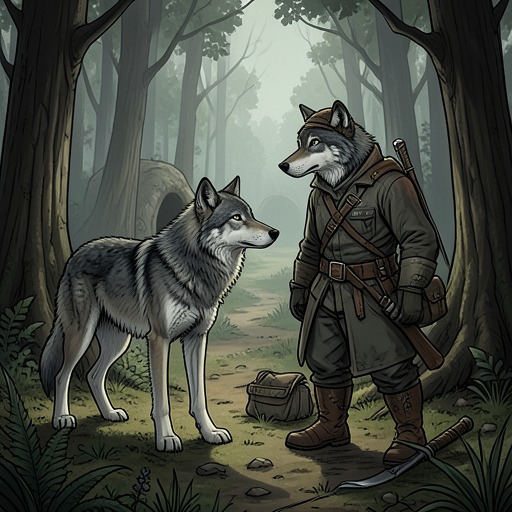
Never Cry WolfKooa is one of Mike’s sled dogs and the central participant in the narrator’s attempt to observe a wolf–dog pairing. When she comes into heat after Mike’s team returns to camp, the possibility of contact with the wolf family turns an ordinary management problem into a short, closely watched episode. Kooa’s actions—following a trail, howling in response to the distant animals, and remaining near camp with Uncle Albert—also make her an active presence in the experiment rather than simply its subject.
Identity and Circumstances
Kooa is a female dog in Mike’s team. Mike had taken the dogs away when he first left the cabin because caribou were scarce and there was not enough food to keep them there. During June, the team stayed with people whose camps were in the caribou’s summer territory; when the deer began returning south, the dogs came back to Mike. Kooa was then coming into heat, a circumstance that caused unrest among the team and gave the narrator an opening to study an interaction he had not been able to observe among the wolves.
The narrator’s knowledge of wolf reproduction was incomplete. He understood that the animals’ mating period was brief and occurred in March, when they moved with the caribou herds, making direct observation difficult. Mike and Ootek had also told him that wolves and dogs could mate when an opportunity arose, although dogs were usually tied up except when working. The narrator proposed using Kooa’s presence to investigate that possibility. Mike agreed, in part because he wanted to learn what kind of sled dogs a wolf–dog cross might produce. The account records the plan and the animals’ association, but gives no report of offspring.
Introducing Kooa to the Wolf Trails
The narrator’s first step was to take Kooa around the new observation site so that the wolves could encounter her scent. She was eager to follow a wolf trail. When they crossed one, she pulled forward and investigated the trail’s markers, and the narrator had difficulty restraining her with a heavy chain leash. He eventually brought her back to the cabin and tethered her for the night. She howled through the night; the account leaves open whether this was frustration at being restrained or a response to what followed.
The next morning, Ootek reported that a large wolf had visited. Its tracks were visible in wet sand on the riverbank, less than a hundred yards from the dog-lines. The narrator considered the presence of the male dogs a possible reason the visitor had not come closer. The tracks showed that Kooa’s scent had been encountered quickly, but did not establish which wolf had visited or what it had intended to do.
For the next stage, the narrator and Ootek set a length of heavy wire between two rocks, about a hundred yards beyond the observation tent and toward the summer den. They led Kooa there the following morning, though she repeatedly tried to go off on her own, and secured her chain to the wire. The arrangement gave her room to move while allowing the observers to keep her in view from the tent. The narrator also believed her position could be controlled with rifle fire if something went wrong. Kooa settled and slept for much of the afternoon. The adult wolves were not visible nearby; the pups appeared intermittently in the grassy area, where they leapt and pounced after mice.
The Evening Encounter
At about 8:30 in the evening, the wolves began their pre-hunt chorus while remaining out of sight behind a ridge south of the den. Kooa rose and joined the howling. The response quickly changed the scene: the wolf family’s song stopped, and all three adult wolves appeared over the ridge. They could see Kooa at a distance of roughly a quarter of a mile.
George and Uncle Albert both started toward her. George’s approach ended when Angeline overtook him; the narrator thought she might have tripped him, but explicitly did not claim certainty. George then lost interest in Kooa, and he and Angeline withdrew to the summer den, where they watched from the edge of the ravine. Their retreat left Uncle Albert to approach Kooa. He moved rapidly, overshot her position, and then turned back. When he came within ten feet, his manner changed, and he stopped with his head lowered. The episode distinguishes the two males’ responses: George’s arrival did not develop into a sustained approach, while Uncle Albert continued toward Kooa.
Release and Return
The animals’ association continued after the encounter. At the cabin, firing into the air did not drive Uncle Albert away; it only made him withdraw a few yards. Keeping Kooa on the dog-line with her teammates seemed likely to provoke a fight, so she was taken inside for the night. The dogs and Kooa vocalized in response to Uncle Albert outside, and Mike was threatening to fire again by morning.
Ootek proposed releasing Kooa. He expected that she would remain near the camp with the wolf, then return home after her heat ended, while the wolf would return to his own kind. Mike accepted the advice. Over the next week, observers sometimes saw Kooa and Uncle Albert walking shoulder to shoulder on distant ridges. They stayed away from both the den esker and the cabin, appearing separate from the human activity around them. The narrator reports their repeated presence together but does not describe their private behavior in detail.
One morning, Kooa was back in her usual place on the dog-line, exhausted but satisfied, as the narrator described her condition. The next evening, Uncle Albert rejoined the wolves’ chorus. The sequence ends with Kooa returned to the team and Uncle Albert back among his own group; the account supplies no further outcome for the proposed wolf–dog cross.
Significance to the Observation
Kooa’s episode gives the narrator an opportunity that ordinary observation had not provided: to see how the wolf family responded when a dog in heat was introduced near its summer den. The events unfold in stages, from scent on the trails to a restrained observation site, a vocal response, and the adult wolves’ arrival. The different reactions of George, Angeline, and Uncle Albert complicate any simple account of a uniform group response, while Ootek’s prediction and Kooa’s eventual return provide a clear beginning and end to the association.
The account also keeps the limits of the experiment visible. The narrator set out to learn about wolf reproductive behavior and the possibility of a wolf–dog cross, but the evidence presented consists of tracks, observed approaches, distant sightings, and Kooa’s return. It establishes that she and Uncle Albert spent time together during her heat, not what biological result followed. Kooa’s role is therefore both practical and evidentiary: her presence made a rare encounter possible, while the incomplete record marks the boundary between observation and conclusion.